
First, the grid
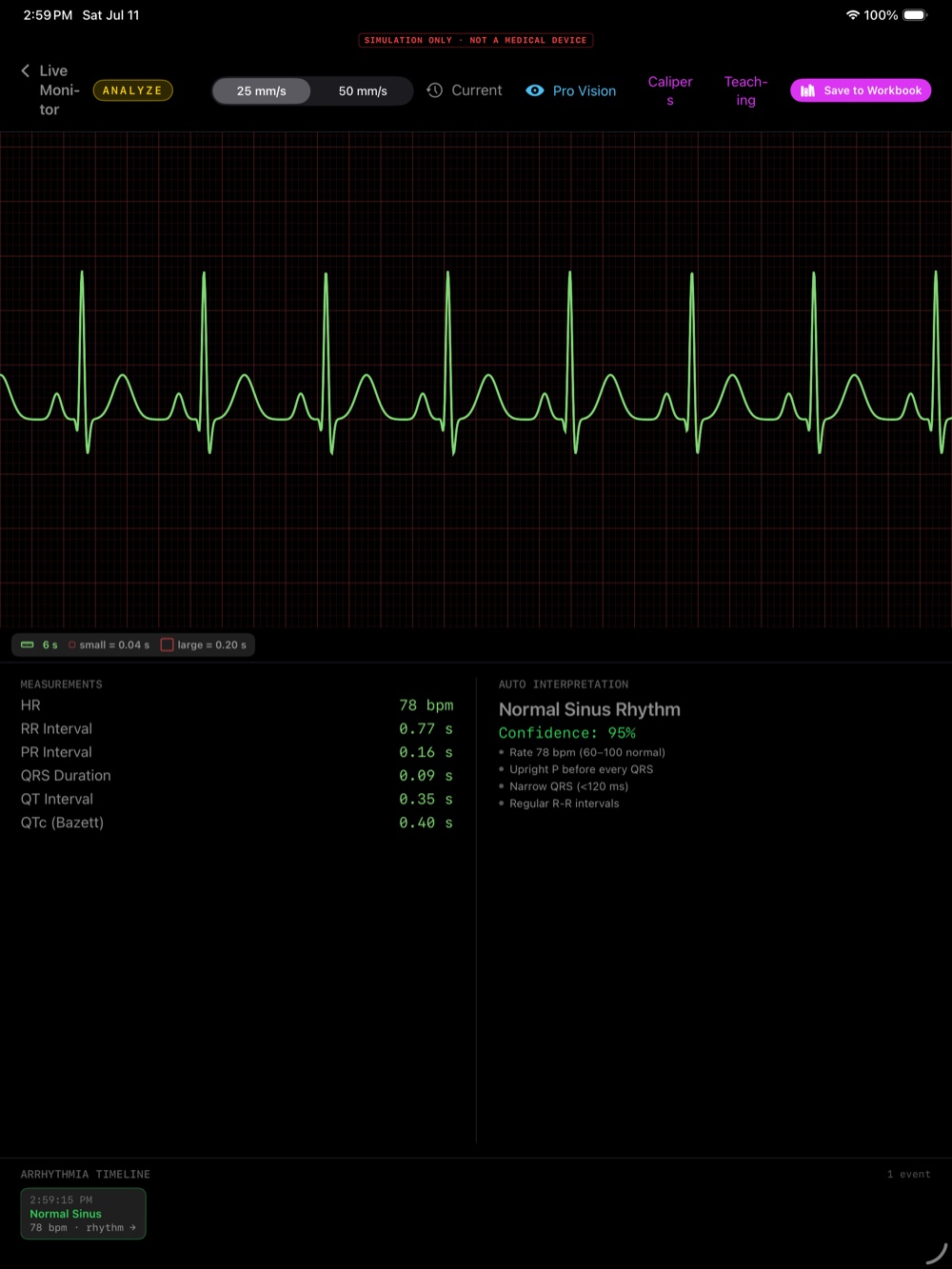
ECG paper (and a good on-screen grid) is calibrated: each small box is 1 mm = 0.04 seconds, and each large box is five small boxes = 0.20 seconds. Vertically, boxes measure amplitude. Knowing the boxes is what lets you turn a shape into a measurement — a PR interval of "four small boxes" is 0.16 seconds.
The six-step scan
- 1 — Rate. Is it fast, slow, or normal? (See "calculating the rate" below.)
- 2 — Rhythm. Are the R–R intervals regular or irregular? "March out" the R waves — mark two on a paper edge and slide along; if they keep landing on R waves, it's regular.
- 3 — P waves. Is there a P wave? Do they all look alike? Is there one P before every QRS?
- 4 — PR interval. From the start of the P to the start of the QRS — normally 0.12–0.20 seconds (three to five small boxes).
- 5 — QRS width. From the start to the end of the QRS — normally narrow, about ≤0.10–0.12 seconds. A wide QRS points toward the ventricles.
- 6 — ST segment. Is it flat, elevated, or depressed?
Calculating the rate
Two common ways. On a six-second strip, count the QRS complexes and multiply by 10. For a regular rhythm, use the big-box method: divide 300 by the number of large boxes between two R waves. Both are quick estimates — the app's Analyze does the exact math for you.
Practice the scan on a live strip
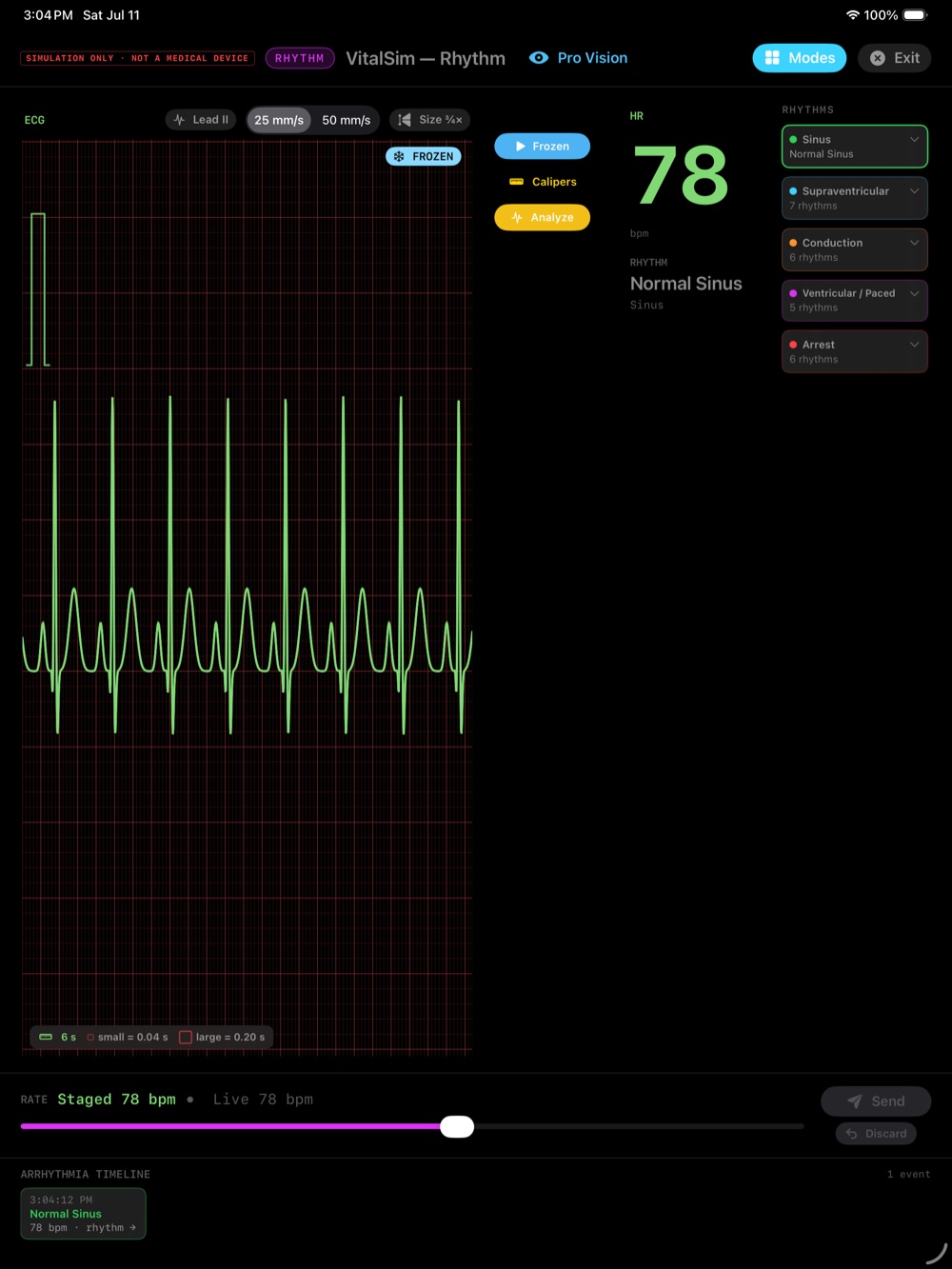
Reading gets fast when you can drive the strip. In VitalSim Rhythm you pick a rhythm, freeze it, and measure it with calipers on a calibrated grid — then Analyze shows the rate and intervals so you can check your six-step read against the numbers.

FAQ
What is the systematic way to read an ECG?
Read every strip the same way: rate, rhythm, P waves, PR interval, QRS width, then ST segment. A consistent order is what makes rhythms recognizable.
How do you calculate heart rate on an ECG?
Count the QRS complexes in a six-second strip and multiply by 10, or — for a regular rhythm — divide 300 by the number of large boxes between two R waves.
What do the boxes on ECG paper mean?
Each small box is 0.04 seconds and each large box (five small) is 0.20 seconds, so you can turn intervals into times.