
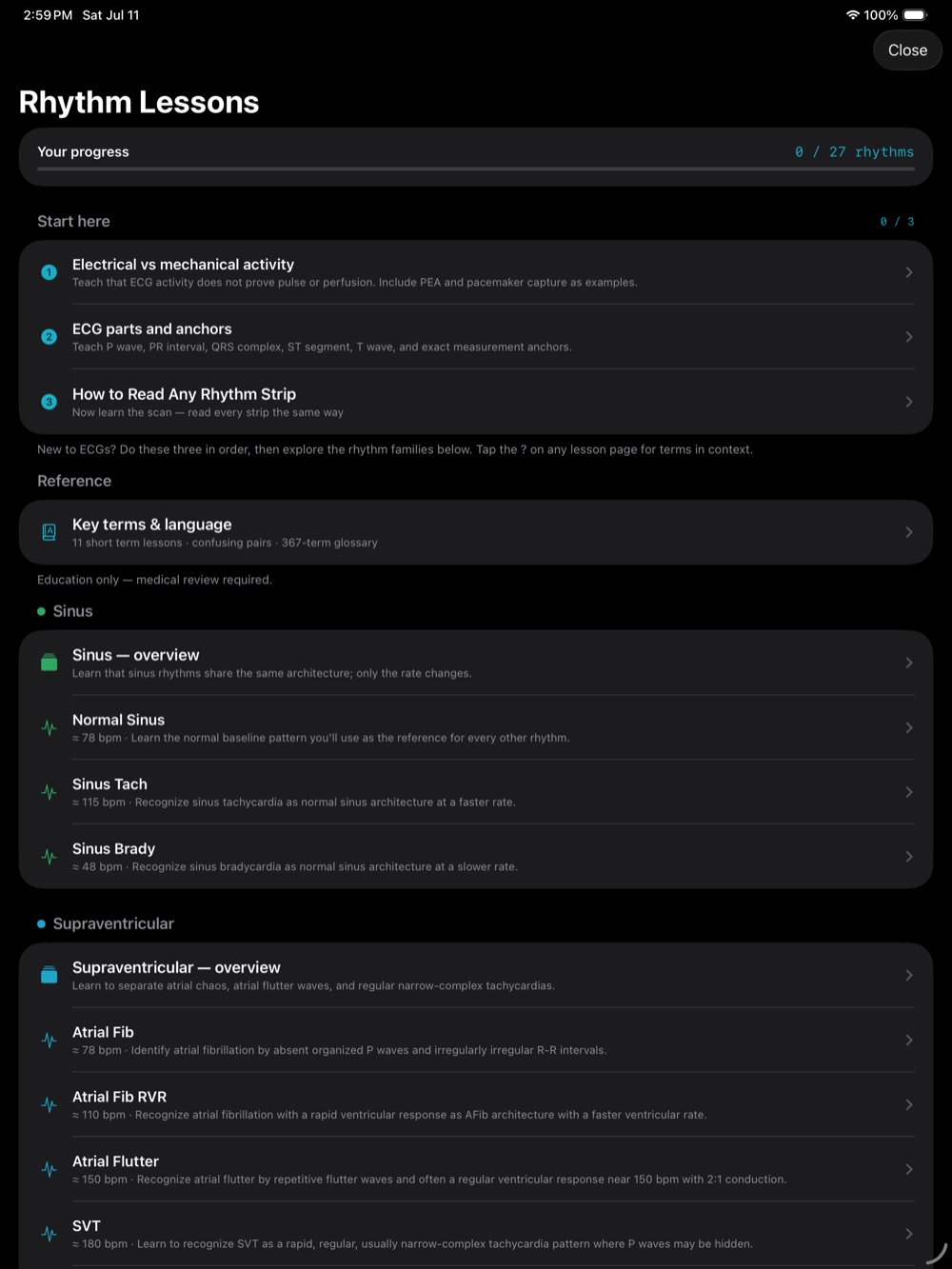
Sinus rhythms
Normal architecture — an upright P before every QRS — with only the rate changing: normal sinus, sinus tachycardia (fast), and sinus bradycardia (slow).
Supraventricular rhythms
Rhythms from above the ventricles: atrial fibrillation (irregularly irregular, no organized P waves), atrial flutter (saw-tooth flutter waves), SVT, and related narrow-complex tachycardias. Afib vs flutter: flutter has regular saw-tooth waves and often a regular ventricular response; afib is chaotic and irregularly irregular.
Conduction rhythms
Where the signal is delayed or blocked between the atria and ventricles — the first-, second-, and third-degree AV blocks — plus the junctional escape rhythm that takes over when the normal pacemaker fails. See the heart blocks guide.
Ventricular and paced rhythms
Rhythms from the ventricles or an artificial pacemaker. A ventricular beat is wide because activation spreads cell to cell, while paced beats are flagged by a pacer spike (wide with ventricular pacing, narrow with atrial pacing). This family holds the slow idioventricular escape rhythm and the paced rhythms; the fast, dangerous ventricular tachycardias are taught with the arrest rhythms — see the dangerous rhythms guide.
Arrest rhythms
The rhythms of cardiac arrest: ventricular fibrillation, pulseless electrical activity, and asystole. A key teaching point: electrical activity on the monitor does not prove a pulse.
Learn all 27 in the app
VitalSim Rhythm teaches all 27 rhythms grouped into these five families — each with a live strip you can drive, a component breakdown, and a quiz — so the families become second nature.

FAQ
What are the main types of cardiac rhythms?
Teaching sets usually group them into five families: sinus, supraventricular, conduction (AV blocks and escape rhythms), ventricular/paced, and arrest.
What's the difference between atrial fibrillation and atrial flutter?
Flutter shows regular saw-tooth flutter waves and often a regular ventricular response; atrial fibrillation is chaotic, with no organized P waves and an irregularly irregular rhythm.
How many rhythms should I learn?
VitalSim Rhythm teaches 27, which covers the common rhythms across all five families — a solid foundation for reading a monitor.