
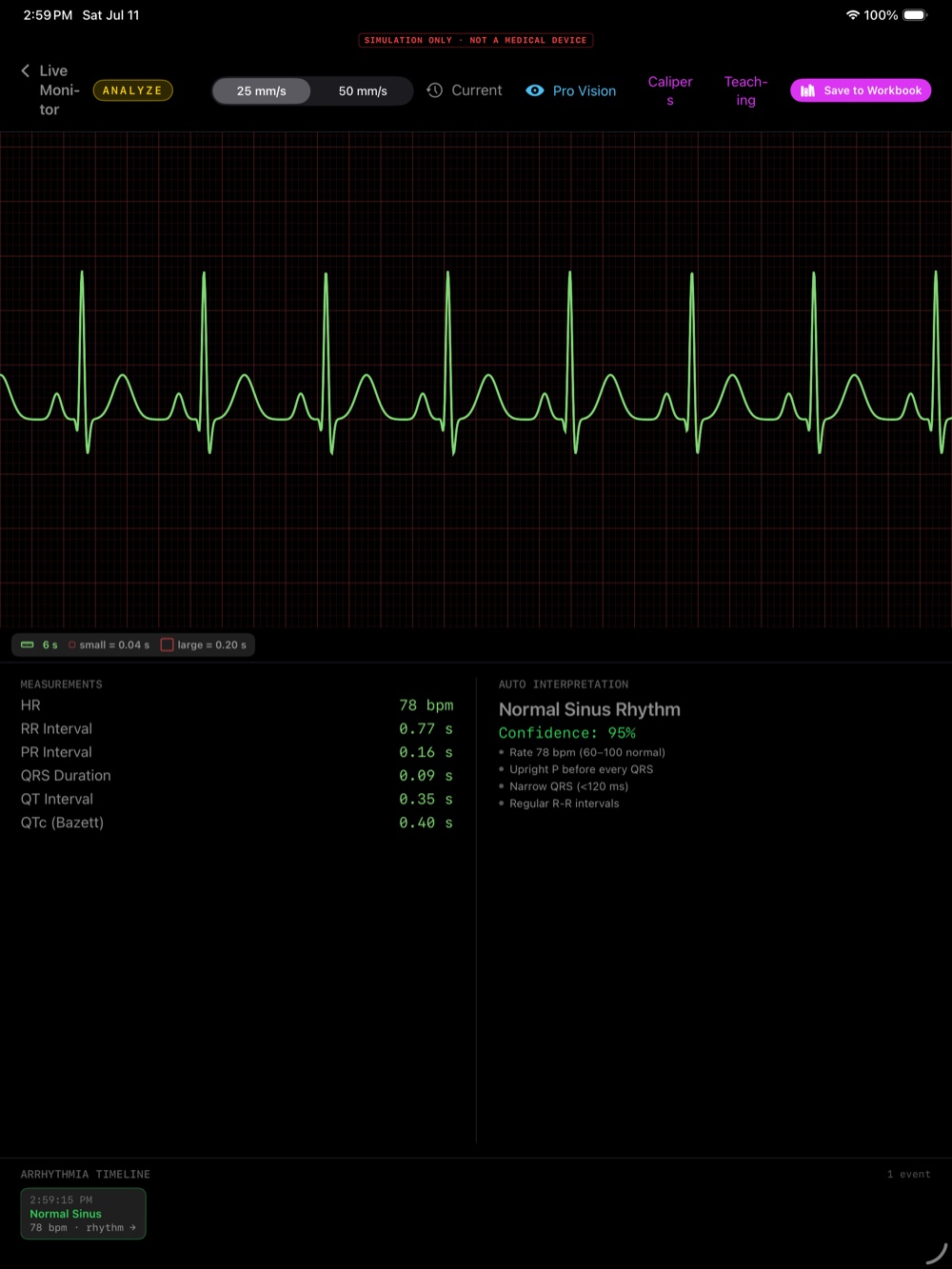
The three waves
- P wave — atrial depolarization (Pro Vision: blue). A small, smooth bump before the QRS; the atria firing.
- QRS complex — ventricular depolarization (red). The tall spike; the ventricles firing. Normally narrow (≤0.10–0.12 s); a wide QRS points toward a ventricular origin.
- T wave — ventricular repolarization (green). The rounded wave after the QRS; the ventricles resetting.
The intervals you measure
- PR interval (Pro Vision: purple) — 0.12–0.20 s. From the start of the P to the start of the QRS: how long it takes the signal to cross the AV node. A long PR is a first-degree block; changing PRs point toward higher-degree blocks.
- QRS duration — about ≤0.10–0.12 s. Narrow is supraventricular; wide suggests the ventricles.
- ST segment (orange) & QT interval. The ST segment sits between the QRS and T (watched for elevation/depression); the QT spans the QRS to the end of the T, and is rate-corrected as the QTc.
Why color-coding helps
"Upright P before every QRS," "wide QRS," "long PR" — these are the phrases every rhythm is built from. When the P, PR, QRS, ST, and T each have their own color, you can see those relationships instead of memorizing them. That's what Pro Vision does in VitalSim Rhythm.
See the beat in color
In VitalSim Rhythm, switch on Pro Vision and the P, PR, QRS, ST, and T light up in their own colors on the live strip — and Analyze measures each interval so the numbers line up with what you see.

FAQ
What does the P wave represent?
Atrial depolarization — the electrical signal that makes the atria contract. It's the small bump before the QRS.
What is a normal PR interval?
About 0.12–0.20 seconds (three to five small boxes), measured from the start of the P wave to the start of the QRS.
What does a wide QRS mean?
A QRS wider than roughly 0.10–0.12 seconds suggests the beat is coming from — or being conducted through — the ventricles rather than the normal pathway.