The systems a one-truck pest control business actually needs
Every "start a pest control business" guide covers the license, the insurance, and the sprayer. Almost none cover what actually determines whether year one feels like a business or a treadmill: the five operating systems behind the work. Here's what each one needs to do — and the cheapest honest way to run it on day one.
1. Schedule & route — the revenue engine
What it must do: hold every account's service frequency, assemble each day's stops, and put them in drive order. Day-one version: a calendar and the zoning method from our route-planning guide. Where software earns its keep: the moment recurring frequencies start colliding with callbacks — usually right when growth starts feeling good.
2. Client records — the book of business
What it must do: one card per property — contacts, history, balances, notes like gate codes and dog names. Day-one version: a spreadsheet, kept ruthlessly current. The failure mode: three months in, when "it's all in my head" meets the first busy week, and the head runs out of room.
3. Field documentation — the protection layer
What it must do: capture findings, photos, applications, and signatures at the stop. This is the system with legal weight — state and federal rules require application records, and service documentation is what settles disputes. Day-one version: phone camera plus a disciplined paper log — and our records guide for what to capture. The upgrade: capture that happens inside the visit itself.
4. Reports & quotes — the professional face
What it must do: turn each visit into a report the customer can read, and each opportunity into a written quote. Day-one version: a clean template you reuse. The trap: reports written at night decay into reports not written at all — the winning system produces the report from what the stop already captured.
5. Money — the part that keeps you open
What it must do: invoice every completed visit, take payment without friction, and know who owes what. Day-one version: same-day invoices, no exceptions, however you send them. The upgrade path is payment at the door — covered in our field-payments guide.
The point of software isn't features — it's one place
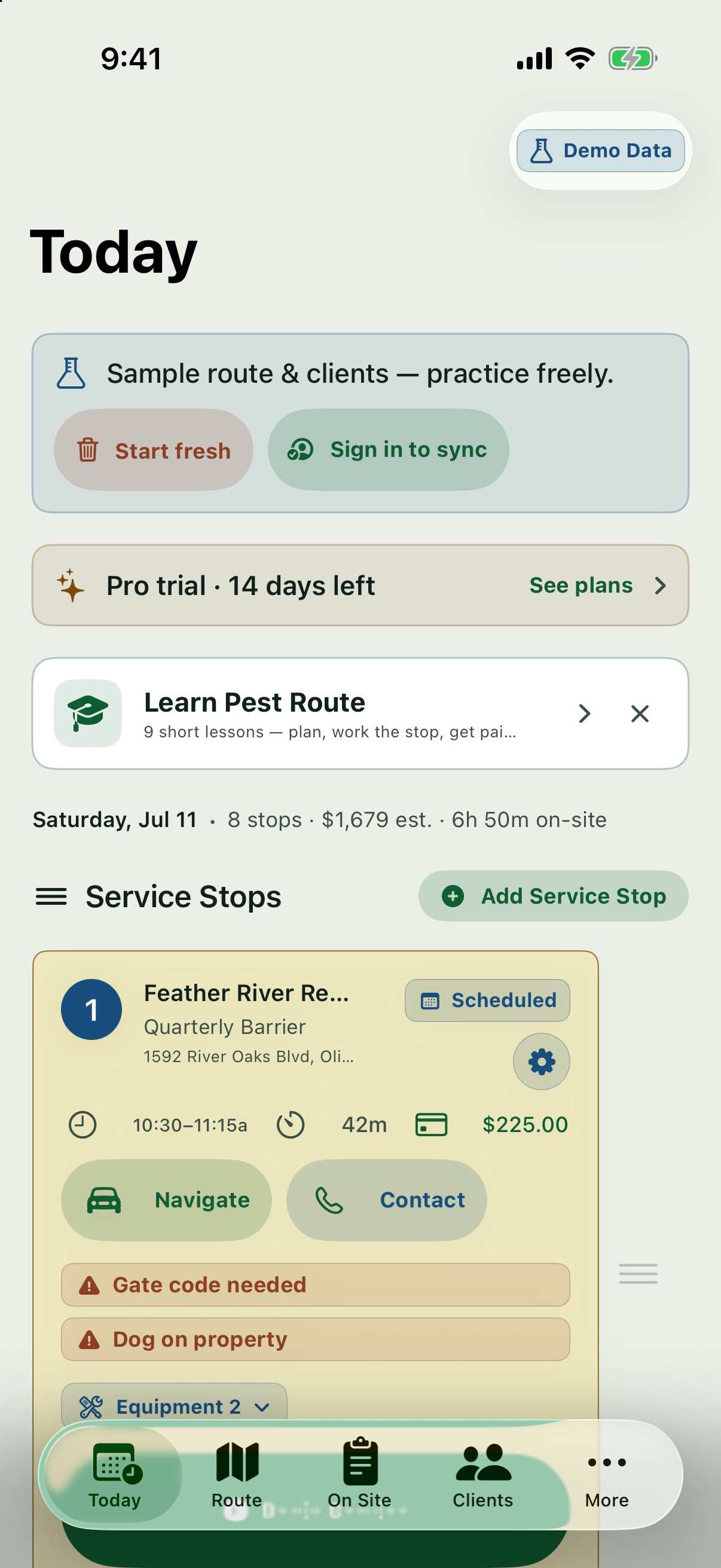
Run each system separately and you'll spend evenings being the integration between them. What a purpose-built tool changes is not any single feature but the seams: the schedule feeds the route, the stop feeds the records, the records feed the report, the report feeds the invoice. That end-to-end seam is exactly what Pest Route is being built to be — native on the phone that's already in your pocket, shaped for one truck first.
Building your operation this year?
Join the launch listFAQ
Can I really start with spreadsheets and paper?
Yes — and you should, if the alternative is agonizing over tools instead of getting accounts. The five systems matter more than what runs them. Just build the habits (same-day records, same-day invoices) that will survive the move to software later.
When is the right time to move to software?
When any system starts leaking: a missed quarterly, a lost chemical log, invoices going out late. That leak is the price signal — it means the manual version is now costing more than a subscription would.
Do the big platforms make sense for a solo operator?
They can — they're proven and broad. The trade-offs are cost models built for fleets and workflows built for offices. The right question isn't "which has more features" but "which was shaped for a day that looks like mine."