
How to plan a pest control route that doesn't eat your day
Planning a pest control route comes down to four moves: cluster your accounts into geographic day-zones, let each account's service frequency decide which week it appears, promise time windows instead of exact appointments, and sequence each day by drive order — not by the order the jobs were booked. Do those four consistently and the fifth takes care of itself: adjusting on the fly without wrecking the week.
1. Zone the map before you touch the calendar
Pull up your accounts on a map and draw day-zones around the natural clusters — the neighborhoods and corridors you can work without long empty drives. Monday might be the north side, Tuesday the river towns, Wednesday the commercial strip. The zones don't need to be perfect; they need to be repeatable, because repetition is what builds route density, and density is what makes a one-truck day profitable.
2. Let frequency place the account, not memory
Every recurring account has a contract rhythm — monthly, bi-monthly, quarterly. Put that rhythm in the system once and let it place the account into the right week of its zone automatically. The failure mode this prevents is the one every solo operator knows: the quarterly account remembered a week late, now due on a day you're working the other side of the county.
3. Sell windows, not appointments
A morning window (8–12) or afternoon window (1–5) gives you the freedom to run stops in geographic order. Exact-time appointments do the opposite — they pin the route to the clock, and one long stop drags every promise after it. Save exact times for the handful of accounts that truly need them, and protect the rest of the day's flexibility.
4. Sequence by drive order — then let the day flex
With the day's stops fixed, order them by the drive: one direction out, the other direction back, no backtracking. Then expect the plan to bend — a callback, a gate that stays locked, a stop that runs long. The test of a good route isn't that nothing changes; it's that a change costs one drag-and-drop, not a redraw of the whole day.
Where Pest Route fits
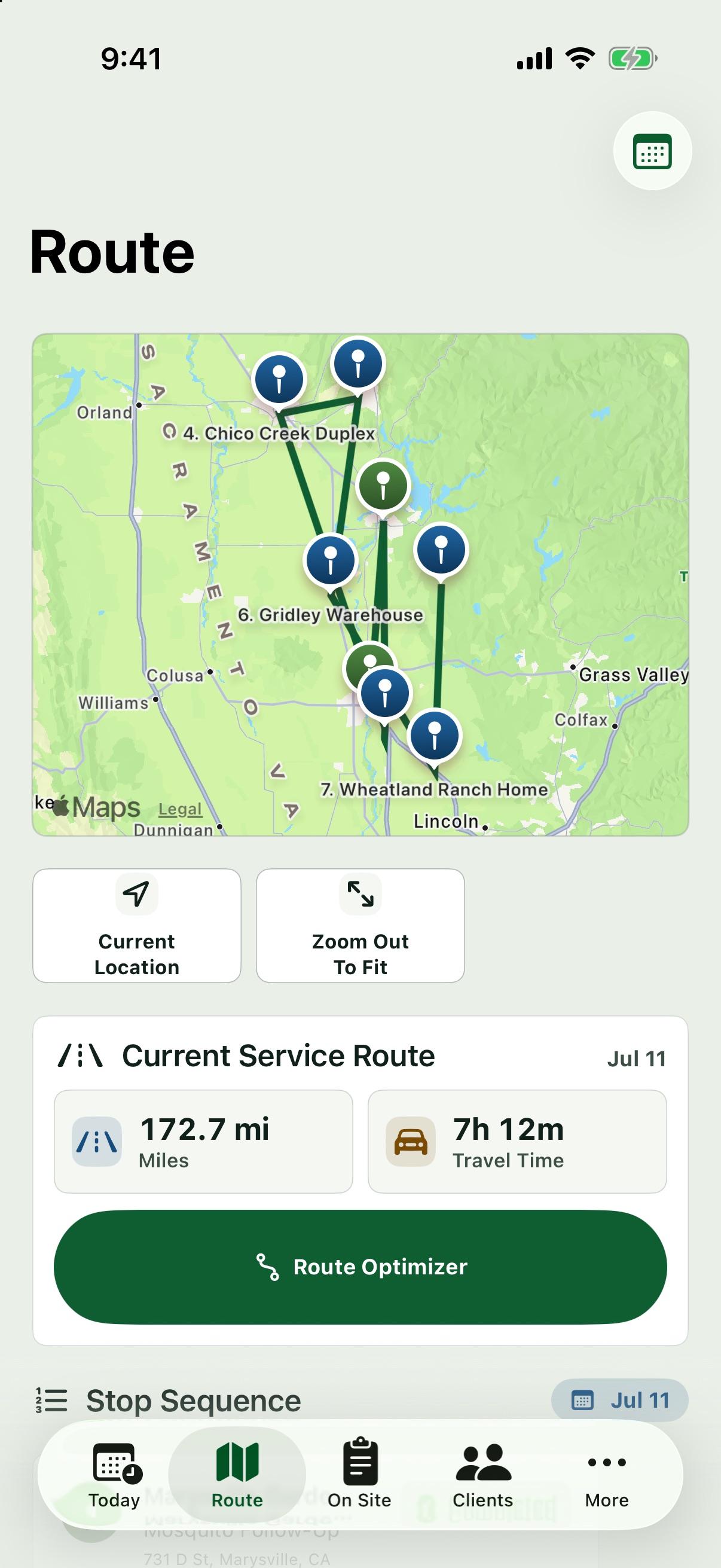
This method is exactly the loop Pest Route is being built around: Calendar holds the frequencies, Today assembles each morning's stops, and Route pins them on a map with the day's miles and drive time — resequencing included when the day changes. It's in development now, with a founding pilot forming.
Planning routes on paper or across three apps?
Join the launch listFAQ
How many stops can one tech run in a day?
It depends on service mix and density more than on effort — a day of clustered exterior-only stops runs very differently from a day of full interior services spread across a county. The honest metric to watch is drive time as a share of the day: when zoning and sequencing push drive time down, capacity rises on its own.
Should I re-optimize the route every morning?
No — re-sequence, don't re-plan. The zones and frequencies are the plan; the morning's job is just putting today's stops in sensible drive order and adjusting when something moves. If you're redrawing zones weekly, the zones were drawn too tight.
Do I need routing software with a small account list?
Under a few dozen accounts, a map and discipline work fine — the method above is free. Software starts earning its keep when recurring frequencies, callbacks, and documentation begin colliding, which for most solo operators arrives with growth whether it's invited or not.