
Nurse educator rounding: a simple system for unit education rounds
Search "rounding" and you'll find patient rounding — hourly rounds, leader rounds, care checks. Educator rounding is a different animal: you're rounding on staff, on their units, to surface education needs, follow up on changes in practice, and stay visible enough that people bring you problems early. Here's a system that makes it consistent instead of vibes-based.
What educator rounding is (and isn't)
It is: a recurring, unit-by-unit presence with three jobs — check on practice changes you've rolled out, surface what staff need next, and keep orientees and preceptors connected to you. It isn't: patient rounding, leader satisfaction rounding, or wandering with warm intentions. The difference between rounding and wandering is that rounding produces a record.
Cadence and coverage
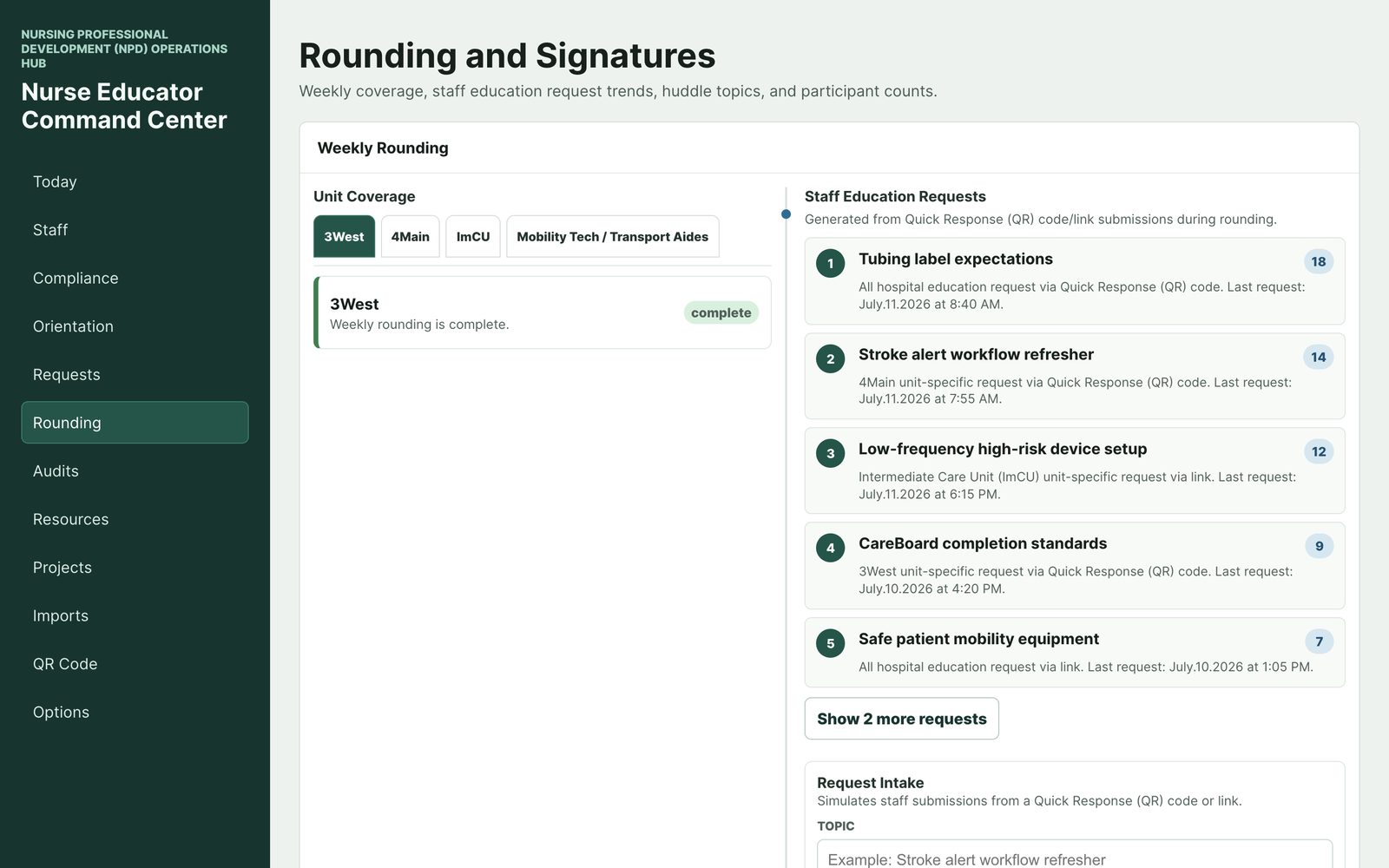
Weekly per unit is the standard worth defending — enough presence that staff expect you, sparse enough to survive your calendar. Two rules make it real: (1) coverage is tracked per unit-week, so "did 3West get a round this week?" has a yes/no answer, and (2) a missed week is rescheduled consciously, not silently absorbed. If you cover four units, that's four checkboxes a week — the world's cheapest accountability system, and the exact thing leadership wishes existed when they ask what education is doing on the units.
What to capture on a round (four fields, ninety seconds)
- Unit + date — the coverage record itself
- Asks — anything staff requested: a refresher, a device question, a policy confusion. Capture verbatim-ish, with who asked, before the next interruption deletes it.
- Observations — things you saw that need education follow-up (not incident reporting — education follow-up)
- Commitments — anything you promised ("I'll send the tubing-label one-pager") with a date
Resist the urge to build a twelve-field form. Four fields you'll actually fill beat a beautiful form you'll abandon by March.
Turn asks into a queue, not a memory
The asks are the yield of rounding — and they're perishable. Every ask gets three attributes within the hour: a priority (is this a safety-adjacent now-thing or a nice-to-have?), a scope (one unit or house-wide?), and a status (new → in progress → delivered). Once asks live in a queue, patterns appear: the same tubing question from two units in one week isn't two asks, it's one education need with evidence. That pattern-spotting — requests ranked by how often they're asked — is what turns rounding notes into your next huddle topic, your next class, and your justification when someone asks why you built it.
Close the loop where people can see it
The fastest way to make rounding self-sustaining: when an ask becomes a delivered piece of education, say so on the next round — "you asked, here it is." Staff who see asks turn into action bring you better asks. That loop is also your evidence trail for professional governance work: requests in, education out, dated.
Where an app fits
Nurse Educator Command Center has a Rounding module built exactly this shape: weekly coverage per unit at a glance, and staff education requests ranked by volume — per unit, with timestamps — feeding an intake queue with priority and aging logic.
FAQ
How long should an educator round take?
Twenty to forty minutes per unit is a workable band — long enough for real conversations, short enough to protect the weekly cadence. The capture (four fields) should cost you ninety seconds, not the round.
What if a unit never has time for me?
That's a finding, not a failure. Track the attempted coverage anyway, shift your timing to their huddle or shift change, and if it persists, it's a conversation with the unit's leadership — with your coverage record as the neutral evidence.
Is educator rounding the same as leader rounding?
No. Leader rounding is about staff experience and retention signals; educator rounding is about practice and learning needs. Same hallway, different jobs — and combining them usually shortchanges both.